Planning to invest in an ERP system or replace your current one? Make a confident decision with transparent ERP pricing and clear implementation costs, so you stay in control of your budget and scale your business with confidence from day one.
Key takeaways
- ERP prices vary based on company size, users, and modules.
- The total ERP cost includes implementation, customization, integrations, and support, not just the subscription.
- Enterprise ERP solutions often use custom offers, which makes price comparisons harder.
- FLOWii offers one of the most affordable cloud ERP entry pricing models, starting from €11.00 per user.
How Much Does ERP Cost?
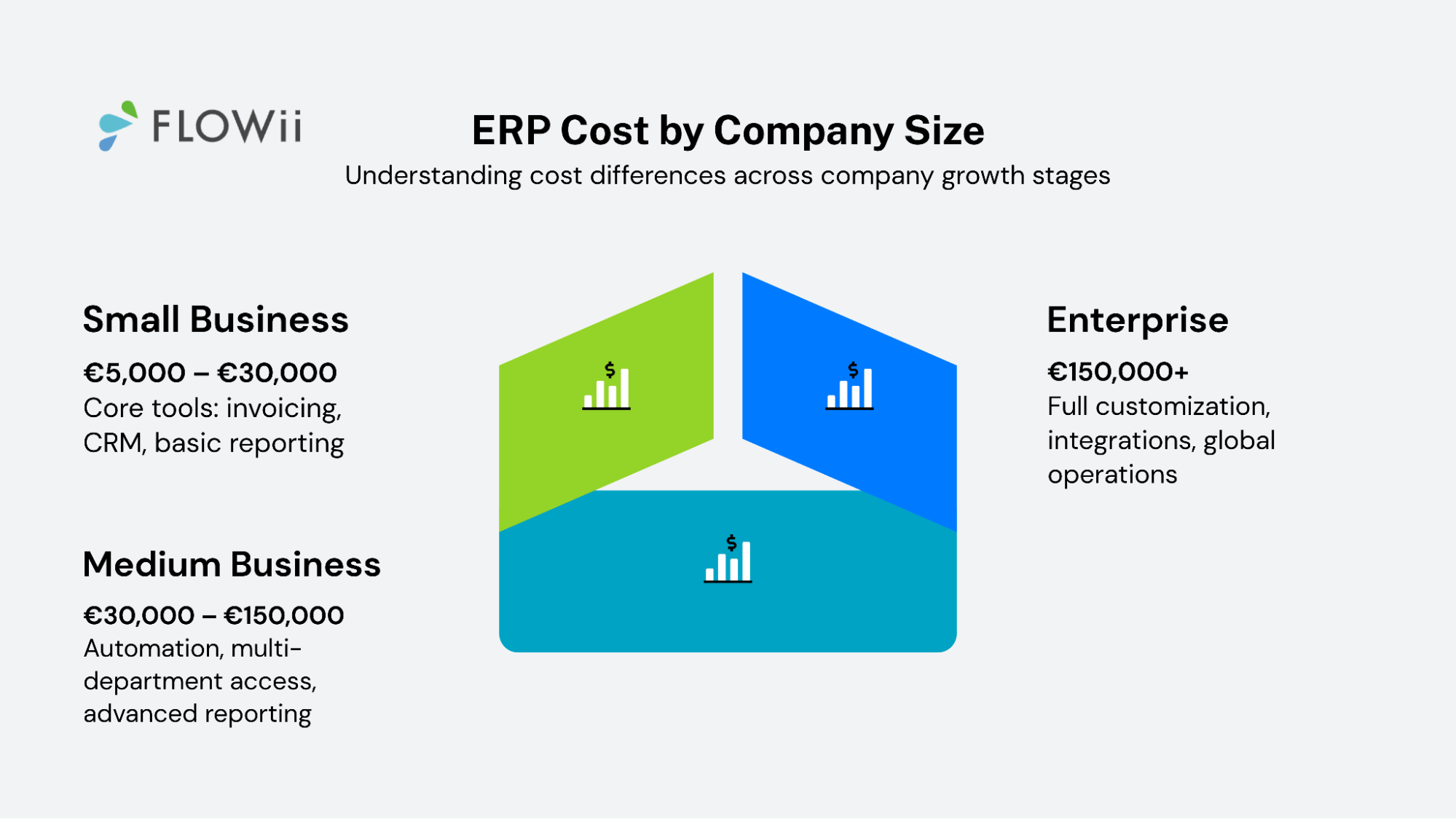
The ERP cost depends on your company size and project scope. Most businesses invest between €10,000–€140,000, while larger or customized implementations can exceed this range.
Industry benchmarks show ERP projects typically represent 1–3% of annual revenue. The real question is: does your investment match your growth plans?
How does ERP pricing vary according to the size of a business?
ERP pricing scales with your company size and number of users. The more processes and people you include, the higher the total investment. The key is choosing a system that grows with you.
-
ERP pricing for small businesses
For small businesses, the ERP price typically ranges from €1,000 to €30,000, depending on the number of users and selected modules. Most companies focus on essential features such as invoicing, CRM, and basic reporting, keeping the ERP system cost predictable and manageable while leaving room to scale.
-
ERP pricing for medium businesses
For medium-sized companies, the ERP cost typically ranges from €30,000 to €150,000. At this level, you usually get multi-department access, automation, and advanced reporting.
TIP: Small and medium-sized companies usually don’t need complex custom solutions. Modern cloud ERP systems offer fast implementation, free trials, and flexible pricing that typically ranges from €10 to €50 per user per month, depending on features and scale.
-
ERP pricing for enterprise businesses
For enterprise organizations, the ERP cost typically starts at €150,000 and can reach several million euros. These solutions usually include full customization, complex integrations, global operations support, and advanced analytics.
ERP price comparison of 6 leading ERP systems
| Software | Price per user | Implementation costs | Free trial | Suitable for |
| FLOWii | €11.00 – €26.00 (Monthly/Annually) | No | 30 days | Small & medium businesses |
| Tally | €544.00 – €1632.00 (only annual license) |
No / Minimal | 7 days | Medium businesses |
| NetSuite | €170.00 – €860.00 (Monthly) - Custom offer |
Yes | No* | Enterprises & growing companies |
| Sage | €170.00 – €430.00 (Monthly) - Custom offer |
Yes | 30 days | Mid-size businesses and enterprises |
| SAP | €100.00 – €215.00 (Monthly) - Custom offer | Yes | No* | Enterprises |
| Oracle | €345.00 – €540.00 (Monthly) - Custom offer | Yes | No* | Mid-size businesses and enterprises |
Some ERP systems offer transparent monthly subscriptions, while others provide pricing only through custom offers. The right choice depends on your size and complexity.
1. FLOWii
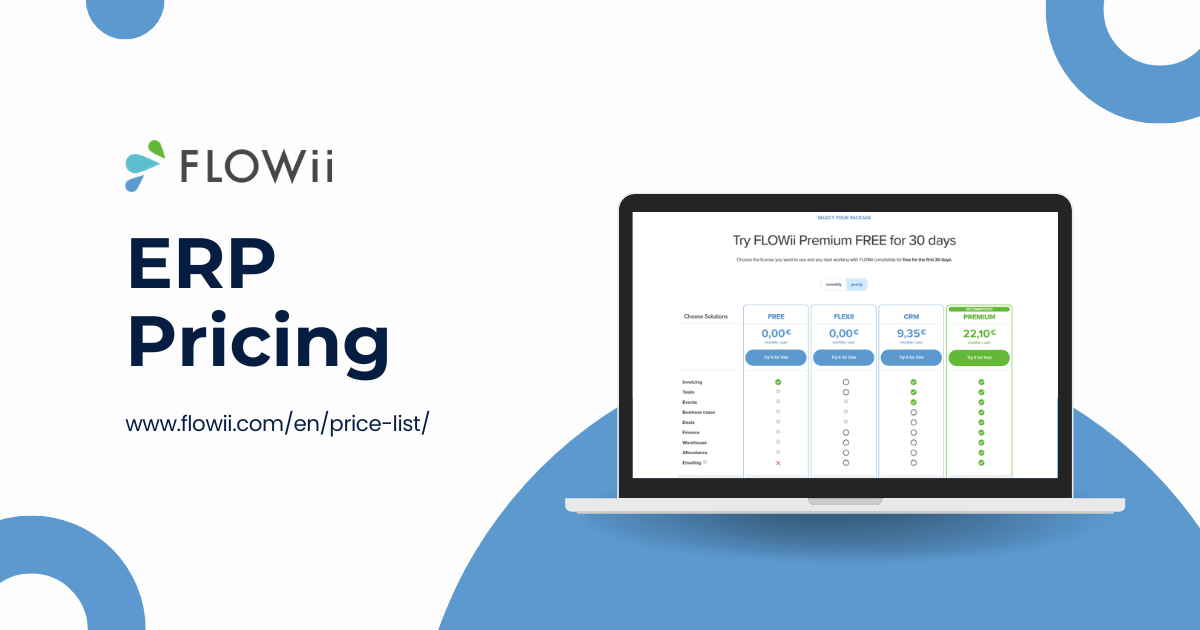
Pricing plans:
Free: Yes (limited features)
Flexi: from €11.00 monthly / €9.35 annually (per user)
Premium: €26.00 monthly / €22.10 annually (per user)
Implementation cost: None. FLOWii is a cloud-based ERP solution with quick setup, so businesses can start using the system without expensive implementation or IT infrastructure.
Free trial: 30 days
Tools: CRM, invoicing, attendance tracking, project management, inventory management, revenue and expenditure tracking, integrations.
Best for: Freelancers and SMEs in services, construction, consulting, marketing, and other growing businesses.
2. Tally Solutions
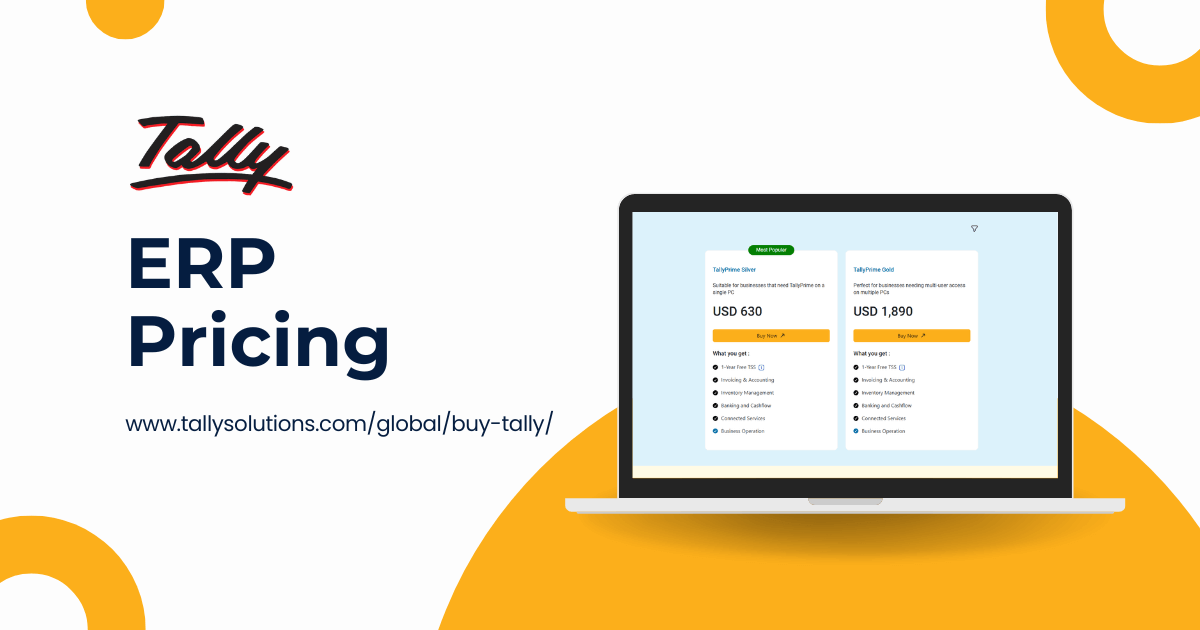
Pricing plans:
TallyPrime Silver: €544.00 monthly
TallyPrime Gold: €1632.00 monthly
Free trial: 7 days
Implementation cost: May vary depending on deployment and partner support. Tally is typically installed locally or configured by a partner, so businesses may incur additional costs for setup, data migration, training, and customization.
Tools: Accounting, invoicing, inventory management, tax compliance, payroll, business operations.
Best for: Medium businesses primarily focused on accounting, bookkeeping, and statutory compliance.
3. NetSuite
Pricing plans: Custom offer only.
Base license + user licenses + modules
Pricing range: Approximately €170–€860 per user per month.
Free trial: No
Implementation cost: NetSuite implementations typically range from €25,000 to €150,000+, depending on the number of users, selected modules, integrations, data migration, and customization required for the project.
Tools: Financial management, CRM, inventory, e-commerce, reporting, global management.
Best for: Enterprises and fast-growing companies with international operations.
NetSuite does not publish fixed pricing because costs are tailored to your business needs. Industry estimates suggest that basic cloud ERP subscriptions often start around €900+ per month for the core platform, with additional user licenses and modules adding to the total (making initial yearly costs €30,000+ common for mid-sized deployments).
4. Sage Intacct
Pricing plans: Custom offer only
Modular pricing based on configuration.
Pricing range: Approximately €170–€430 per user per month.
Free trial: 30 days
Implementation cost: Sage Intacct implementation typically ranges from €15,000 to €60,000+, depending on the number of entities, modules, integrations, data migration, and required customization.
Tools: Advanced accounting, financial reporting, compliance, automation.
Best for: Mid-sized companies with strong finance and reporting requirements.
5. SAP ERP
Pricing plans: Custom offer (partner-based)
Price range: Approximately €100–€215 per user per month.
Free trial: No (only partner demo or pilot)
Implementation cost: Typically ranges from €20,000 to €100,000+, depending on the number of users, modules, integrations, and level of customization required.
Tools: Financial management, sales, purchasing, inventory, production, reporting, analytics.
Best for: Mid-size businesses and enterprises with structured processes, manufacturing or distribution needs.
6. Oracle

Pricing plans: Custom enterprise contracts
Module-based pricing
Price range: Approximately €345–€540 per user per month.
Free trial: No
Implementation cost: Oracle ERP implementations typically range from €100,000 to €500,000+, depending on the number of modules, integrations, data migration, and the complexity of global business processes. Large enterprise deployments can exceed this range due to extensive customization and multi-country compliance requirements.
Tools: Enterprise finance, procurement, risk management, global compliance, advanced analytics.
Best for: Mid-size to enterprise organizations with complex global operations.
What are the key factors affecting ERP costs?
Here are the most important cost drivers you should understand before choosing an ERP solution:
-
Number of Users
Most ERP vendors charge per active user. That means every additional employee with system access increases your monthly ERP system cost.
If your team grows from 5 to 25 users, your subscription can multiply quickly. Always plan pricing not just for today, but for the team you expect in 2–3 years.
-
Modules and Features
Core tools like invoicing or CRM are affordable. Advanced automation, production, BI reporting, or multi-warehouse management raise the price.
-
Implementation & Setup
Implementation is where many companies underestimate costs. Data migration, process mapping, training, and configuration require time and expertise.
The more fragmented your current systems are, the higher your ERP implementation cost will be. A clean structure lowers risk and budget.
-
Customization & Integrations
Standard ERP is always more affordable. But what happens when your processes do not fit into a standard template?
The moment you request custom workflows or connect your ERP with e-commerce, payroll, banking, or warehouse systems, development time increases and so does your total investment. The more systems you want to connect, the more complex and expensive the project becomes.
-
Support & Maintenance
ERP is not a one-time purchase. Updates, technical support, and user onboarding can create recurring expenses — unless they are already included in the subscription.
What are the most expensive items in the cost of ERP implementation?
The biggest part of the cost of ERP implementation is rarely the license itself. The highest expenses usually come from:
- Implementation services (analysis, setup, project management),
- Customization of workflows and processes,
- Data migration from old systems,
- Integrations with other tools,
- Training and onboarding.
The more complex your processes, the higher the total ERP implementation cost.
What are the main ERP pricing models?
ERP vendors use different pricing structures. Understanding the model behind the price helps you compare offers correctly and avoid surprises.
Subscription-Based (SaaS)
- Monthly or annual subscription fees per user
- Predictable recurring costs
- Updates and support often included
- Lower upfront investment
Best for companies that prefer flexibility and scalable pricing.
Perpetual License (On-Premise)
- One-time license fee per user
- Annual maintenance fees (typically 15–25%)
- Higher upfront investment
- Requires internal IT infrastructure
Suitable for businesses that want full control over deployment.
Custom / Enterprise Contracts
- Tailored pricing based on modules and users
- Often includes base platform fee + add-ons
- No public price list
- Costs vary significantly by scope
Common in mid-market and enterprise ERP solutions. Pricing is usually tailored to the number of users, selected modules, and overall project scope. Final costs are often determined after consultation and detailed requirement analysis.
Modular Pricing
- Pay only for selected modules
- Core system + optional add-ons
- Costs grow as functionality expands
Useful when you want to start small and scale gradually. It allows you to control your ERP cost while expanding functionality only when your business truly needs it.
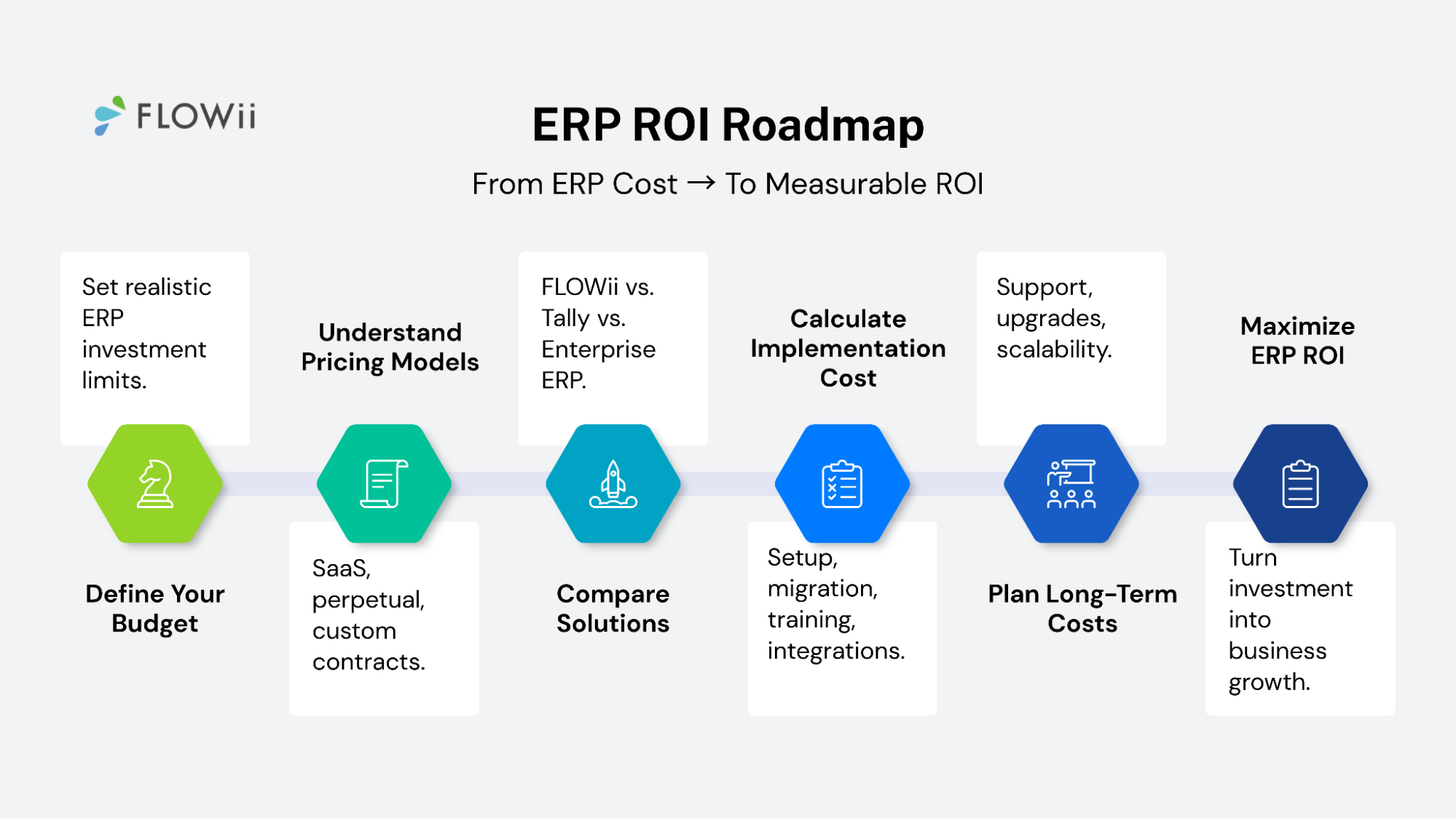
How can you accurately forecast your ROI for ERP implementation?
Start by defining measurable business goals, calculating your current operational costs, and building a realistic ROI forecast based on the total ERP investment over the next 3 to 5 years.
When you rely on real data instead of assumptions, ROI becomes a strategic decision tool, not just a financial estimate.
Final words
Growth brings more clients, more invoices, and more complexity. A smart ERP system helps you stay organized, efficient, and in control of your finances, projects, and operations.
Start your 30-day free trial and see exactly what your ERP investment delivers before committing.
FAQ
What is ERP price?
ERP price refers to the total cost of purchasing, implementing, and operating an ERP system. It typically includes software licenses or subscription fees, implementation and setup, data migration, integrations with other tools, user training, and ongoing support or maintenance. The final ERP cost depends on factors such as the number of users, selected modules, level of customization, and the overall complexity of the business processes.
Is ERP pricing based on users, modules, or company size?
Yes, usually all three factors influence the final ERP cost.
How to check ERP pricing?
How can we reduce the total cost of ERP implementation?
You can reduce the total cost of ERP implementation by starting with a simple setup and expanding the system gradually as your business grows.
Key ways to lower ERP implementation costs:
-
Start with essential modules only and add more features later
-
Avoid heavy customization in the initial phase
-
Choose a cloud-based ERP system with transparent pricing
-
Prepare and clean your data before migration
-
Train key users early to reduce support and onboarding costs
What are the most common mistakes when choosing ERP pricing?
-
Focusing only on the subscription price and ignoring implementation and integration costs.
-
Underestimating the number of users needed as the company grows.
-
Choosing unnecessary modules that increase the overall ERP investment.
-
Ignoring long-term scalability, which can lead to expensive system changes later.
-
Over-customizing the system early, which significantly increases implementation costs.
Is there an affordable ERP solution available?
Yes, affordable ERP solutions are available, especially in the form of modern cloud-based ERP systems designed for small and medium-sized businesses. These systems use subscription pricing, which significantly lowers upfront costs compared to traditional on-premise ERP solutions.
For example, FLOWii is a cloud ERP solution that offers transparent pricing, a quick setup, and a free trial, making it accessible for growing companies. The system starts at around €26 per user per month, allowing businesses to manage CRM, invoicing, projects, and operations without expensive implementation costs.
How can you compare ERP pricing plans in the best way?
Look beyond the monthly price per user and compare the total cost of ownership over 3–5 years. Include implementation, customization, integrations, training, and ongoing support. Make sure you are comparing the same pricing model (SaaS vs. custom enterprise contracts) and evaluate which features are included, scalability options, and long-term flexibility.