You can have a powerful tool, but without the right setup, it remains unused. CRM system implementation is the moment when technology turns into the engine of your sales.
In this article, you’ll learn how CRM implementation works in practice, what to watch out for during the process, and how to get the most out of a modern CRM system.
Key Takeaways
- CRM implementation decides whether your CRM truly improves sales and processes.
- Success requires a clear plan, defined workflows, and team adoption.
- CRM implementation cost depends on company size, but the right setup delivers measurable ROI.
- Choosing the right platform or working with an experienced CRM implementation consultant significantly increases your chances of success.
What Is CRM Implementation?
As you already know, CRM (Customer Relationship Management) is a system for managing customer relationships and sales activities in one place.
CRM implementation is the process of setting up and adapting the system to your company so it supports real sales results. It includes process configuration, data setup, and team training.
CRM Implementation Example
A growing service company implemented FLOWii after struggling with scattered data and missed follow-ups. They started by defining clear goals: better pipeline visibility and faster response times. Then they mapped their sales process, cleaned their contact database, configured sales stages, and assigned one internal owner to manage the rollout.
They launched with a simple setup and focused on team adoption before adding automation. Within a few weeks, managers had real-time insight into deals and forecasts, and response times improved significantly. The key insight? Successful CRM implementation depends more on clear processes and ownership than on complex features.
How Does CRM Implementation Work in Practice?
CRM implementation is not just about installing software. It’s a structured process that reshapes how your company manages sales, communication, and customer relationships.
This CRM implementation process requires clear planning and alignment with your overall business strategy. Below are the essential steps that define a structured CRM implementation strategy.
1. Setting Clear Goals
Every successful CRM implementation starts with these questions:
- What are we trying to achieve?
-
What specific problem should this CRM implementation solve?
-
Which sales metrics do we want to improve?
-
Where are we currently losing deals or time?
-
What processes need better visibility or control?
-
How will we measure success after launch?
Clear answers create direction.
2. Executive Buy-in & Ownership
Every CRM implementation needs a clear owner. Without management support and accountability, adoption drops and the system becomes just another tool.
3. Analyzing Processes and Business Needs
Look at how deals move today. Where do leads get stuck? Where do you lose opportunities? CRM should fix those gaps.
4. Creating a CRM Implementation Plan
Build a clear CRM implementation plan that defines scope, timeline, responsibilities, and priorities. It should also outline key milestones and assign clear ownership for each phase of the CRM implementation process to keep the project aligned and on track.
5. System Setup and Configuration
Configure pipelines, automation rules, and permissions so the system supports your workflow.
6. Data Migration
Import contacts, deals, and historical data carefully. Clean data is the foundation of a successful CRM system implementation.
7. Testing and Team Training
Test the workflows before going live and train your team to use the system confidently.
8. CRM Implementation Best Practices
Define clear ownership from the start and begin with a simple setup you can scale later. Focus on adoption before automation and measure ROI from day one to track real impact. A structured approach significantly increases the chances of successful CRM implementation.
CRM Implementation Challenges You Shouldn’t Ignore
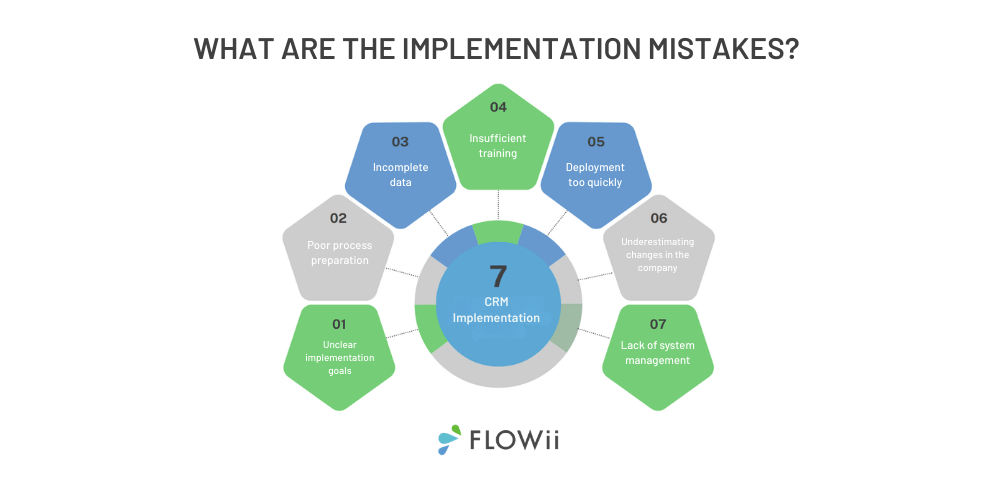
Even strong CRM implementation services fail when preparation is weak. Watch out for these critical risk factors:
- Lack of a defined CRM implementation strategy
- Misalignment between CRM configuration and actual workflows
- Poor data governance during migration
- Limited adoption due to weak onboarding
- Absence of testing phase before go-live
- No structured change management
- Missing long-term system governance
Addressing these issues significantly increases the probability of successful CRM implementation.
How Much Does CRM Implementation Cost?
CRM implementation can cost a few thousand euros or escalate to six figures. It all depends on how ambitious your transformation is.
Here’s the risk. Studies report that up to 70% of CRM initiatives fail due to strategy and adoption issues. The wrong setup can be far more expensive than the software itself.
CRM Implementation Cost by Company Size
CRM implementation can become one of the more significant IT investments a company makes. Costs vary depending on customization, CRM integrations, and overall project complexity.
Here’s a simplified CRM implementation cost breakdown by company size:
- Small projects: approximately €5,000 to €14,000
- Mid-sized companies: approximately €14,000 to €46,000
- Large implementations: often €46,000 to €140,000 or more
These ranges usually include system configuration, data migration, integrations, user training, and sometimes external CRM implementation services. The more complex your processes and the more customization you require, the higher the total investment.
Why Expensive CRM Implementations Fail
Spending more doesn’t always mean better outcomes. Many large CRM system implementations don’t reach their goals because processes aren’t aligned and users aren’t onboarded effectively.
How to Calculate ROI of CRM Implementation?
CRM is not an expense. It’s an investment.
To measure the ROI of CRM implementation, use this formula:
ROI (%) = (Gain from CRM – Cost of CRM) / Cost of CRM × 100
ROI (Return on Investment) shows how much profit you generate for every euro invested. If your ROI is 100%, you earned back what you invested. If it’s 200%, you doubled it.
What counts as gain?
- More closed deals
- Faster sales cycles
- Time saved on admin work
- Lower marketing costs
With a system like FLOWii, you can track sales performance, pipeline value, and revenue in real time, making ROI calculation simple and data-driven. Instead of guessing, you work with clear numbers.
Real Example of CRM ROI
A company invests €1,200 per year in CRM.
After implementation:
- 2 extra deals per month
- €150 average profit per deal
Monthly gain: €300
Annual gain: €3,600
ROI = (3,600 – 1,200) / 1,200 × 100 = 200%
The investment didn’t just return. It doubled.
Curious about CRM experience? Read the article to learn more.
How Long Does CRM Implementation Take?
The CRM implementation timeline depends on your company size, number of users, and level of customization. The simpler your setup, the faster you can go live.
Typical time frames:
- Small businesses (cloud CRM): 1 to 7 days
- Small to mid-sized companies: 2 to 6 weeks
- Mid-sized companies with integrations: 1 to 3 months
- Large enterprise solutions: 3 to 12 months
The real question is not just how long it takes but how well you plan it.
With FLOWii, CRM implementation is immediate. As a cloud-based solution, it does not require complex installation or external technical setup. You can configure the system directly according to your processes and start using it right away, without the need for a dedicated implementation specialist.
What Are the Best Platforms for CRM Implementation?
The right CRM platform depends on your company size, process complexity, and required features. A small business needs simplicity and speed. A corporation needs scalability and deep integrations.
| Company Size | Recommended Platform | Why It’s a Good Fit | Typical Use Case |
| Small & Medium Businesses | FLOWii | Easy to use, fast setup, combines CRM with invoicing, projects, and business management in one system, integrations | Companies up to ~50 employees that want sales, customers, and finances in one place |
| Mid-Sized & Growing Sales Teams | Pipedrive | Strong pipeline management, sales reporting, and automation features | Growing companies with active sales teams and higher deal volume |
| Enterprise & Corporations | SAP | Enterprise-level scalability, ERP integration, advanced analytics | Large organizations with complex processes and global operations |
TIP: The best CRM implementation platform is the one that matches your growth stage, not the one with the most features.
Conclusion
If your business is growing, spreadsheets and scattered tools are no longer enough. CRM helps you manage sales, customers, and performance in one system while delivering strong return on investment.
Ready to see the difference? Try FLOWii free for 30 days and experience structured growth.